
Last updated: March 2026
Some links on this page are affiliate links. If you buy through them we may earn a small commission at no extra cost to you.
If you are building a new gaming PC in 2026 and shopping AMD, one question comes up before almost everything else: AM4 or AM5? The platform you choose determines your CPU options, your memory type, your motherboard, and your upgrade path for the next several years. This guide breaks down the honest differences between the two platforms so you can make the right call for your budget and goals.
On This Page
- AM4 vs AM5: At a Glance
- What Are AM4 and AM5?
- The Core Differences
- Gaming Performance
- The Real Decision: Budget
- AM4 CPU Options Worth Knowing in 2026
- AM5 CPU Options Worth Knowing in 2026
- What About Cooler Compatibility?
- The Zen 6 Factor
- Should You Upgrade an Existing AM4 Build to AM5?
- Which Platform Is Right for You
- Frequently Asked Questions
- Final Verdict
AM4 vs AM5: At a Glance
- AM4: AMD’s DDR4 platform, introduced in 2017. Mature, affordable, and at the end of CPU development. Best value under $1000.
- AM5: AMD’s current DDR5 platform, introduced in 2022. Active CPU development through at least 2027. Required for Ryzen 7000, 8000, and 9000 series. The right choice at $1500 and above.
- Platform cost difference: AM5 typically costs more than AM4 once you factor in motherboard and DDR5 memory pricing. DDR5 prices have risen significantly in 2026. Check current listings before estimating the gap.
- Gaming performance gap: Narrow at 1440p and 4K where the GPU does most of the work. More meaningful at 1080p high FPS or in CPU-intensive games.
- Upgrade path: AM4 is a dead end. AM5 is expected to receive Zen 6 desktop CPUs, currently expected in 2027.
What Are AM4 and AM5?
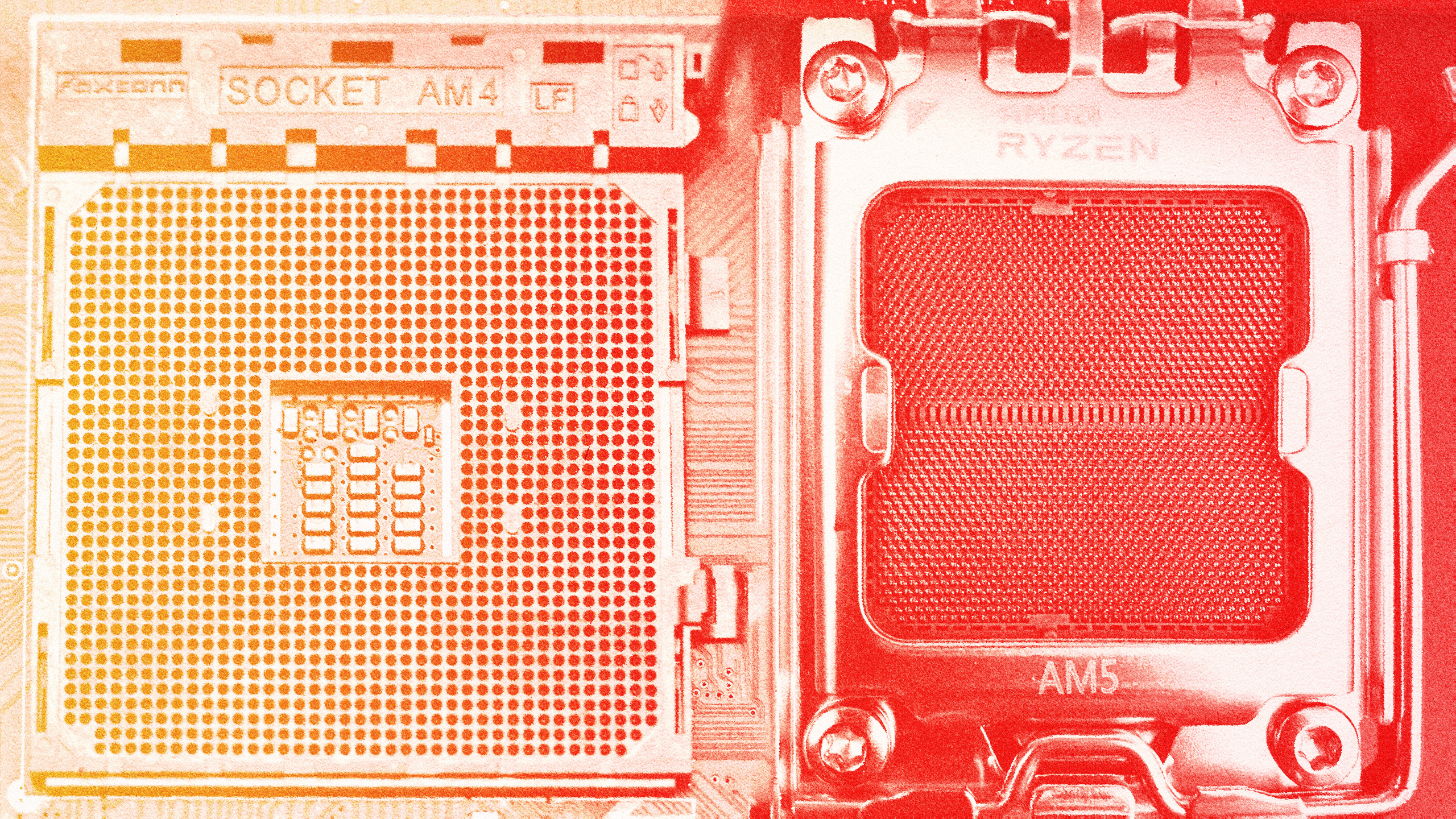
AM4 and AM5 are CPU socket standards. The socket is the physical and electrical interface between the processor and the motherboard. Think of each socket as a platform generation. Swapping a CPU works freely within a platform, but switching platforms requires a new motherboard and new memory. AM4 uses DDR4 memory. AM5 uses DDR5. The two are not cross-compatible in any way.
AMD introduced AM4 in 2017 and supported it across five Ryzen generations, from Ryzen 1000 through Ryzen 5000. That longevity made AM4 one of the most cost-effective platforms in PC history. AM5 launched in 2022 with Ryzen 7000 and currently supports Ryzen 7000, 8000, and 9000 series processors. AMD has publicly committed to AM5 support through at least 2027, and Zen 6 desktop CPUs are expected to use the same socket.
The Core Differences
Gaming Performance: How Much Does the Platform Actually Matter?
This is where most articles overcomplicate things. The honest answer depends heavily on resolution and how you are gaming.
At 1440p and 4K, the platform gap is small
At 1440p and 4K, gaming is primarily GPU-limited. The graphics card is doing most of the heavy lifting, and most modern CPUs, including the AM4 Ryzen 5 5600, are fast enough that they are not meaningfully holding back the GPU. In a GPU-limited scenario, switching from AM4 to AM5 usually produces only a small difference in average frame rates. If you are pairing either platform with a strong GPU like the RX 9060 XT or RTX 5070, the graphics card is the real performance story at these resolutions.
At 1080p high FPS, AM5 shows a clearer advantage
At 1080p targeting 144Hz and above, the CPU plays a much larger role. Games become more CPU-limited at lower resolutions and higher frame rates because the GPU finishes frames faster and the processor has to keep up. In this scenario, AM5 CPUs like the Ryzen 5 7600 and Ryzen 7 9800X3D show a more meaningful lead over comparable AM4 chips. If competitive gaming at high refresh rates is your priority, AM5 produces better 1% lows and frame-time consistency, both of which matter more than average FPS for smooth gameplay.
In CPU-intensive games, AM5 wins more clearly
Strategy games, open-world simulations, city builders, and heavily modded games stress the CPU much harder regardless of resolution. In those scenarios, AM5 CPUs paired with faster DDR5 memory deliver a measurable advantage over AM4. DDR5’s higher bandwidth helps in workloads that push large data sets through the CPU, and the newer Zen 4 and Zen 5 architectures also bring higher instructions-per-clock than Zen 3.
The Real Decision: Budget
Platform choice is ultimately a budget decision. Here is how we think about it at LoadedRig.
Under $1000, AM4 is the right call
At this budget, the AM5 platform premium costs you GPU quality, and the GPU is the most important component in a gaming PC. Stepping from AM4 to AM5 at a $1000 budget usually forces you into a weaker graphics card to cover the extra platform cost. That weaker GPU hurts gaming performance far more than an older CPU platform does. Our Best $1000 Gaming PC Build for 1080p 2026 and Best $1000 Gaming PC Build for 1440p 2026 both use AM4 for exactly this reason.
For GPU recommendations that pair with either platform at this budget, see our best GPUs under $500 2026 guide.
$1500 and above, AM5 is the right call
At $1500 the budget is large enough to absorb the AM5 platform premium without sacrificing GPU quality. You still get a strong graphics card, and you gain a real future CPU upgrade path in the process. There is very little reason to build on AM4 at $1500 or above when the extra AM5 cost is manageable. Our Best $1500 Gaming PC Build for 1440p 2026 and Best $2000 Gaming PC Build for 1440p / 4K 2026 both use AM5 for this reason.
Once you know which platform makes sense for your budget, the next step is choosing the right board. See our Best Motherboards for Gaming 2026 guide for the AM4 and AM5 boards we recommend by build tier.
The crossover point
If your budget lands between $1000 and $1500, the practical crossover is closer to $1200 to $1300. Whichever platform you land on, make sure you also have the right amount of system RAM for the games you play. See our How Much RAM Do You Need for Gaming 2026 guide before locking in your memory kit. Below that, protecting GPU budget usually matters more, so AM4 still makes sense. Once you move above that range, AM5 starts looking more compelling if you plan to keep the system for more than a couple of years and want the option to upgrade the CPU later without replacing the whole platform.
AM4 CPU Options Worth Knowing in 2026
AM4 is at the end of its development life, but the existing CPU lineup is still very usable for budget-minded gaming builds. These are the options that matter most.
AM5 CPU Options Worth Knowing in 2026
AM5 has the broader and more current lineup. These are the CPUs that matter most for gaming builds in 2026.
What About Cooler Compatibility?
One practical advantage of AM5 that often gets overlooked is cooler compatibility. AM5 uses the same cooler mounting dimensions as AM4, which means many quality AM4 coolers will work on AM5 motherboards without modification or an adapter kit.
If you already own a good aftermarket cooler from an AM4 build, there is a strong chance it will carry over to AM5. That slightly reduces the real-world platform cost difference for anyone upgrading from an existing AM4 system rather than building completely from scratch.
The Zen 6 Factor
One of the strongest arguments for AM5 in 2026 is what comes next. AMD has confirmed that Zen 6 desktop CPUs will use the AM5 socket. Early expectations had Zen 6 desktop arriving in 2026, but more recent reporting points to 2027 for the desktop rollout.
What that means in practice is simple: if you build on AM5 today with a B650 board, your motherboard should remain relevant for AMD’s next desktop CPU generation. That is a meaningful upgrade runway that AM4 cannot offer. AM4’s CPU development effectively ended with Ryzen 5000.
The delay also means there is no real reason to wait. AM5 is not about to be replaced in 2026. It still has meaningful life left as a current platform, which makes it the better long-term choice for new mid-range and higher-end builds.
Should You Upgrade an Existing AM4 Build to AM5?
This is a different question from choosing a platform for a brand-new build, and the answer is more nuanced.
If you are already running a Ryzen 5000 CPU and gaming at 1440p or 4K, moving to AM5 is not a priority. At those resolutions the GPU is doing most of the work, so the real-world gaming improvement from switching platforms is usually small. In most cases, your money is better spent on a stronger graphics card.
If you are still running an older AM4 chip like a Ryzen 3000-series processor and gaming performance is clearly falling behind, the most cost-effective move is often upgrading to a Ryzen 5 5600 on your existing board rather than changing platforms entirely. That gives you meaningful gains for far less money than a full motherboard and memory rebuild.
The case for moving an existing AM4 system to AM5 is strongest if you also need a motherboard replacement anyway, or if you are targeting very high refresh rates at 1080p and want to remove the CPU as a bottleneck before a major GPU upgrade.
Which Platform Is Right for You
- Building new under $1000: AM4. Save the platform premium and put that money into the GPU instead. See our Best $1000 Gaming PC Build for 1080p 2026 or Best $1000 Gaming PC Build for 1440p 2026.
- Building new at $1500 or above: AM5. The platform premium is manageable at this budget, and the upgrade path is worth it. See our Best $1500 Gaming PC Build for 1440p 2026 or Best $2000 Gaming PC Build for 1440p / 4K 2026.
- Already on AM4 with a Ryzen 5000 CPU: Stay put unless you have a specific CPU-limited use case. Focus your upgrade budget on the GPU first.
- Already on AM4 with a Ryzen 3000 CPU or older: A Ryzen 5 5600 upgrade is usually the smartest move before considering a full platform jump.
- Primarily gaming at 1440p or 4K: The platform gap is small. GPU quality matters much more than CPU socket at these resolutions.
- Primarily gaming at 1080p high FPS or playing CPU-heavy games: AM5 shows a clearer advantage. If budget allows, it is the stronger long-term platform.
Frequently Asked Questions
Is AM4 still worth buying in 2026?
Yes, for new builds under $1000. The platform is mature, affordable, and the Ryzen 5 5600 is still a capable gaming CPU. The money saved by choosing AM4 instead of AM5 can go directly toward a stronger graphics card, which has a larger impact on gaming performance at most resolutions. For builds at $1500 and above, AM5 is usually the better choice.
Does DDR5 make a big difference for gaming?
Not dramatically for average frame rates at 1440p and 4K. At those resolutions games are typically GPU-limited, so the memory bandwidth difference between DDR4 and DDR5 does not produce large FPS gains. Where DDR5 can help is with 1% lows and frame-time consistency, especially in CPU-heavy titles. The bigger advantage is long-term headroom as game engines evolve.
Will AM5 boards work with Zen 6 CPUs?
AMD has confirmed that Zen 6 desktop CPUs will use the AM5 socket. Current B650 motherboards are expected to support the new processors with BIOS updates, though final compatibility always depends on motherboard firmware support. Zen 6 desktop chips are currently expected in 2027.
Do AM4 coolers work on AM5?
In most cases, yes. AM5 uses the same cooler mounting pattern as AM4, which means many popular coolers are compatible with both sockets. Always confirm compatibility with the manufacturer, but models like the Thermalright Peerless Assassin 120 SE and Noctua NH-D15 support both platforms.
Which is better for gaming, AM4 or AM5?
AM5 is the faster platform overall, but the difference depends on how you game. At 1440p and 4K the gap is usually small because the GPU becomes the performance limit. At 1080p high refresh rates or in CPU-heavy games, AM5 shows a clearer advantage. For most gamers building at $1500 or above, AM5 is the better long-term choice.
How much more does an AM5 build cost than AM4?
Typically around $150 to $200 more when building new, though this gap has widened in 2026 due to significant DDR5 memory price increases driven by ongoing supply shortages. DDR5-6000 CL30 32GB kits have risen considerably from where they were in 2024. Always check current memory pricing before estimating total platform costs, as the real difference may be higher than the historical baseline.
Final Verdict
The AM4 vs AM5 decision ultimately comes down to budget and upgrade expectations.
If you are building a gaming PC under $1000, AM4 still makes a lot of sense. The platform is mature, affordable, and the Ryzen 5 5600 remains a strong gaming CPU. The money you save on the platform can go directly into a better graphics card, which improves gaming performance far more than a newer CPU platform at this price range.
If you are building at $1500 or above, AM5 is usually the smarter long-term choice. The platform supports DDR5 memory, newer CPU architectures, and future Zen 6 processors. That means you can upgrade your CPU later without replacing the entire system.
For most gamers, the simplest rule is this: protect GPU budget at lower price tiers with AM4, and move to AM5 once your build budget comfortably supports the newer platform.