
Last updated: April 2026
Some links on this page are affiliate links. If you buy through them we may earn a small commission at no extra cost to you.
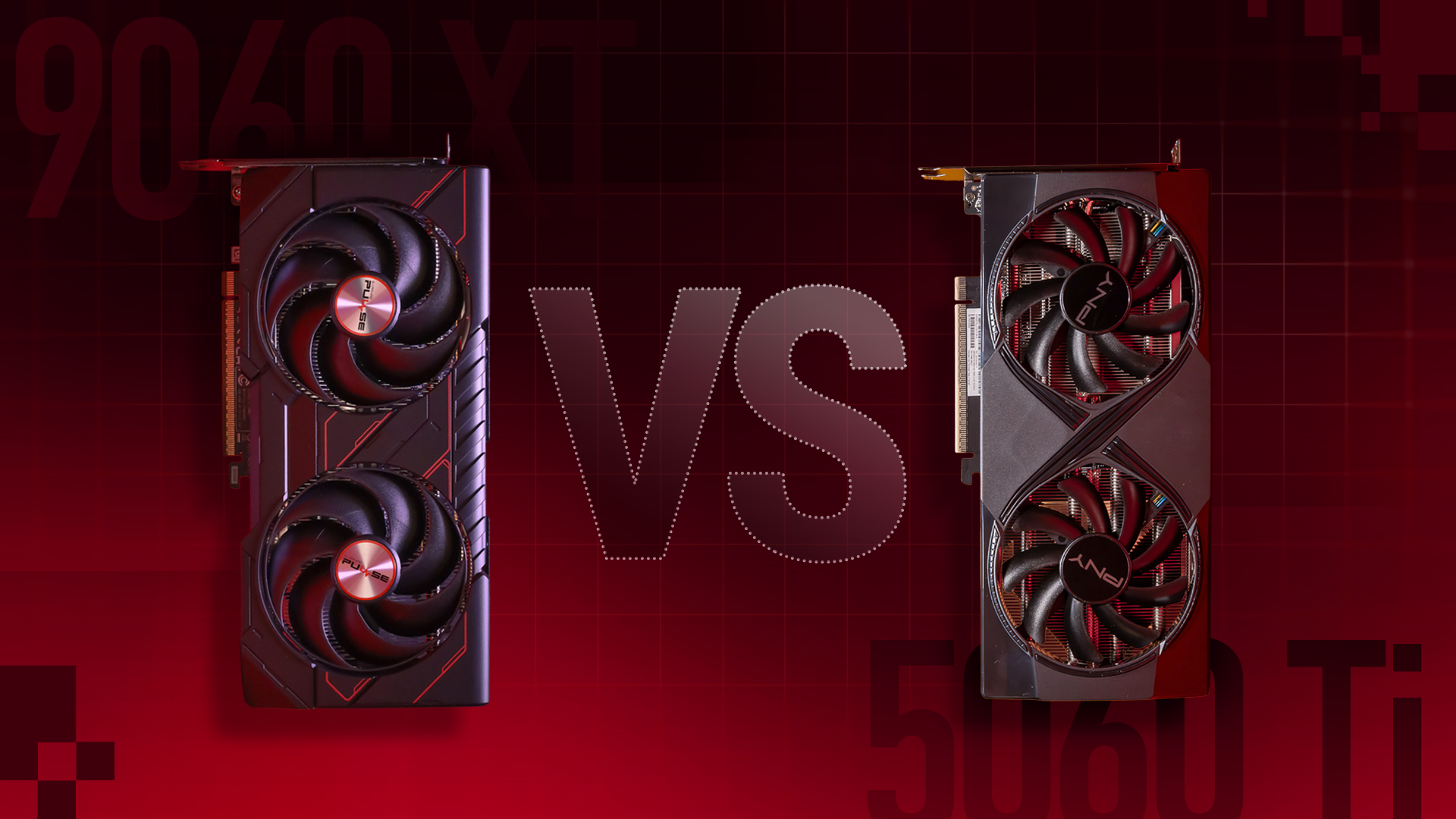
The RTX 5060 Ti vs RX 9060 XT decision in 2026 is not a two-card comparison. Both GPUs ship in 8GB and 16GB configurations, and those versions do not behave closely enough to collapse into a single answer. Before you decide between Nvidia and AMD, you need to decide which version of each card you are actually comparing. The 8GB and 16GB variants have different VRAM ceilings, different performance profiles under pressure, and different risk levels depending on your platform. This guide on the RTX 5060 Ti vs RX 9060 XT 2026 breaks all four configurations down so you can make the right call for your resolution, your game library, and your system.
On This Page
- Quick Answer
- Specs Comparison
- The Four-Card Reality
- Performance at 1080p
- Performance at 1440p
- Ray Tracing and DLSS vs FSR
- Same Name, Different Ceiling
- The PCIe Platform Problem
- Which Should You Buy
- What Not to Do
- Frequently Asked Questions
- Final Verdict
RTX 5060 Ti vs RX 9060 XT: At a Glance
| RTX 5060 Ti 8GB | RTX 5060 Ti 16GB | RX 9060 XT 8GB | RX 9060 XT 16GB | |
|---|---|---|---|---|
| VRAM | 8GB GDDR7 | 16GB GDDR7 | 8GB GDDR6 | 16GB GDDR6 |
| PCIe Config | x8 | x8 | x16 | x16 |
| Best For | Budget 1080p esports only | 1080p/1440p, RT and DLSS priority | Budget 1080p, less bad on older platforms | 1080p/1440p best value |
| Verdict | Not recommended for most buyers | Best Nvidia pick at this tier | Not recommended for most buyers | Best overall value at this tier |
Quick Answer: RTX 5060 Ti vs RX 9060 XT 2026
The answer depends entirely on which configuration you are comparing.
If you are comparing the 8GB versions, the RTX 5060 Ti 8GB is the stronger card in normal gaming scenarios. But neither 8GB card is a strong buy for most people in 2026 for anything beyond budget 1080p esports gaming with realistic expectations. The 8GB ceiling is already showing up in current AAA titles and both cards carry real longevity risk.
If you are comparing the 16GB versions, the decision becomes genuinely interesting. The RTX 5060 Ti 16GB is the stronger pick if ray tracing, DLSS 4, and Nvidia’s broader feature ecosystem matter to you. The RX 9060 XT 16GB is the stronger pick if raw value and native rasterization performance at current street prices matter more. They are within 3 to 5 percent of each other in most gaming scenarios. Pricing, features, and platform compatibility determine the winner for your specific situation.
If you are upgrading an older PCIe 3.0 or 4.0 system, avoid both 8GB cards. The compounding effect of VRAM overflow on a slower PCIe bus can make the real-world gap between 8GB and 16GB versions much larger than reviews on modern test systems suggest. The RTX 5060 Ti 8GB is especially vulnerable here due to its x8 PCIe lane configuration.
Specs Comparison
| Card | Architecture | VRAM | Memory Type | PCIe Config | TDP | MSRP |
|---|---|---|---|---|---|---|
| RTX 5060 Ti 8GB | Blackwell | 8GB | GDDR7 | PCIe 5.0 x8 | ~180W | $379 |
| RTX 5060 Ti 16GB | Blackwell | 16GB | GDDR7 | PCIe 5.0 x8 | ~180W | $429 |
| RX 9060 XT 8GB | RDNA 4 | 8GB | GDDR6 | PCIe 5.0 x16 | ~170W | $299 |
| RX 9060 XT 16GB | RDNA 4 | 16GB | GDDR6 | PCIe 5.0 x16 | ~182W | $349 |
Street prices as of April 2026 are higher than MSRP on most configurations due to ongoing memory supply constraints. Always check current listings before ordering.
One spec worth noting before the benchmarks: the RTX 5060 Ti uses PCIe 5.0 x8 while the RX 9060 XT uses PCIe 5.0 x16. This does not matter in normal gaming conditions. It matters significantly when VRAM is exceeded. More on that in the PCIe section below.
The Four-Card Reality
Before you read the benchmarks, understand what you are actually choosing between. This is not a two-card decision.
| Card | VRAM | Best Use Case | Verdict |
|---|---|---|---|
| RTX 5060 Ti 8GB | 8GB GDDR7 | Budget 1080p esports only | Not recommended for most buyers |
| RTX 5060 Ti 16GB | 16GB GDDR7 | 1080p and 1440p, RT and DLSS priority | Best Nvidia pick at this tier |
| RX 9060 XT 8GB | 8GB GDDR6 | Budget 1080p, less bad on older platforms | Not recommended for most buyers |
| RX 9060 XT 16GB | 16GB GDDR6 | 1080p and 1440p, best value | Best overall value at this tier |
The sections below explain the reasoning behind each verdict. If you already know which configuration fits your situation, jump to the Which Should You Buy section.
Performance at 1080p
At 1080p, this is where 8GB can still survive, but only under the right conditions.
Both the RTX 5060 Ti and RX 9060 XT 16GB deliver strong performance across competitive and AAA titles at 1080p. The RTX 5060 Ti 16GB holds a small average lead of approximately 3 percent over the RX 9060 XT 16GB across a broad game sample. In practice you would not notice this difference in actual gameplay. Individual titles vary more than that based on optimization, driver state, and rendering path.
The 8GB versions tell a different story. In competitive and esports titles that stay well within the 8GB VRAM budget, both 8GB cards perform close to their 16GB counterparts. That is the best-case scenario for these cards and the only scenario where buying 8GB makes reasonable sense.
In demanding AAA titles at 1080p, the gap between 8GB and 16GB versions of the same card begins to open sharply. Hardware Unboxed’s independent testing of the RTX 5060 Ti 8GB found it delivering 67 FPS in The Last of Us Part II at 1080p while the 16GB version delivered 109 FPS at the same settings. Indiana Jones and the Great Circle crashed on the 8GB RTX 5060 Ti at 1080p Ultra. These are not future problems. They are happening now in titles available today.
The practical 1080p picture: if your game library is competitive titles and well-optimized older games, both 8GB cards remain workable. If you play newer AAA titles or want to run maximum settings, 16GB is the right starting point even at 1080p.
Performance at 1440p
At 1440p, this is where the 8GB vs 16GB divide becomes unavoidable.
The RTX 5060 Ti 16GB and RX 9060 XT 16GB are within 3 to 5 percent of each other in native rasterization at 1440p across a broad game sample. Both are legitimate 1440p cards at high settings. The RTX 5060 Ti 16GB takes a small lead in certain titles. The RX 9060 XT 16GB reclaims ground in others. In most games a buyer would not feel the difference if both cards were running side by side.
Where the RTX 5060 Ti 16GB pulls ahead more meaningfully is in ray tracing workloads. At 1440p with ray tracing enabled, Nvidia’s RT architecture advantage and DLSS 4 with Multi Frame Generation create a more noticeable performance gap in supported titles. If ray tracing is a priority at 1440p, the RTX 5060 Ti 16GB is the cleaner pick.
The 8GB cards at 1440p face a growing list of titles where VRAM pressure causes frame time inconsistency and texture quality degradation. TechSpot’s testing found the RX 9060 XT 8GB was 11 percent slower than the 16GB version even on PCIe 5.0, and the gap widened significantly on older platforms. The RTX 5060 Ti 8GB faces similar pressure with the additional complication of its x8 lane configuration. Neither 8GB card is a confident 1440p recommendation in 2026.
For more context on where VRAM thresholds sit at this resolution, see our 8GB vs 16GB VRAM for Gaming 2026 guide.
Ray Tracing and DLSS vs FSR
This is where the two card families genuinely diverge and where Nvidia’s case is strongest.
The RTX 5060 Ti carries Nvidia’s fifth-generation Tensor cores and fourth-generation RT cores. DLSS 4 with Multi Frame Generation is the best upscaling and frame generation solution available at this price tier. In supported titles, DLSS 4 delivers meaningfully better image quality than FSR 4 and the frame generation implementation is more mature. For buyers who play a game library with strong DLSS 4 support, the RTX 5060 Ti 16GB is the card that maximizes that investment.
The RX 9060 XT runs on RDNA 4 with improved ray tracing performance over RDNA 3. AMD has closed a real gap in ray tracing capability with this generation, but Nvidia still holds a clear advantage in heavy RT scenarios. FSR 4 has improved significantly and competes closely with DLSS 4 in supported titles, but DLSS 4 remains the more consistent result across a wider range of games.
The honest summary: if ray tracing and upscaling quality are priorities, Nvidia is the right choice at this tier. If most of your game library is rasterization-focused or uses FSR 4 well, the RX 9060 XT 16GB delivers comparable gaming quality at a lower current street price.
Same Name, Different Ceiling
This is the section most comparison articles skip and most buyers most need to read.
The RTX 5060 Ti 8GB and RTX 5060 Ti 16GB share the same Blackwell die, the same core count, and the same clock speeds. On a spec sheet they look nearly identical. In practice, once VRAM pressure rises, they can perform like different products. The same is true for the RX 9060 XT 8GB and RX 9060 XT 16GB. Same RDNA 4 architecture, same compute units, same name. But once a game exceeds the 8GB buffer, performance does not gently decline. It can fall apart quickly.
Nvidia provided only the 16GB RTX 5060 Ti to reviewers at launch. Hardware Unboxed purchased an 8GB unit independently for testing and found severe limitations in several current titles at settings that were entirely manageable on the 16GB version. In The Last of Us Part II, the 16GB version delivered 109 FPS while the 8GB version managed 67 FPS at the same 1080p settings. Indiana Jones and the Great Circle crashed entirely on the 8GB model.
The cards share a name. They do not share a performance ceiling.
The buyer mistake this section is designed to prevent: assuming that the 8GB version of either card is a minor variant of the same product. It is not. It is a different product with a lower ceiling, and that ceiling is already being hit in 2026 titles.
The PCIe Platform Problem
This only matters when VRAM runs out. But when it does, the difference between these two cards becomes much more pronounced.
When a GPU exceeds its VRAM buffer, it falls back to system RAM. That data travels through the PCIe bus, and the bandwidth available on that bus determines how badly performance degrades. The RTX 5060 Ti uses a PCIe 5.0 x8 configuration. The RX 9060 XT uses PCIe 5.0 x16. Under VRAM overflow conditions, the RX 9060 XT has access to twice the PCIe bandwidth as the RTX 5060 Ti on the same platform.
TechSpot’s testing found that even on PCIe 5.0, the RTX 5060 Ti 8GB cannot overcome the x8 lane limitation once VRAM is exceeded. The RX 9060 XT 8GB, with its x16 configuration, handles overflow more gracefully on PCIe 4.0 and PCIe 5.0 platforms. This creates an unusual situation: if you are on an older platform and are seriously considering an 8GB GPU, the RX 9060 XT 8GB is actually the less bad option of the two specifically when VRAM overflows.
The recommendation this leads to is the same either way: buy the 16GB version of whichever card you choose. The PCIe lane story is not a reason to buy the 8GB RX 9060 XT. It is a reason to understand that the 8GB RTX 5060 Ti carries extra risk on older platforms, and that risk compounds with the 8GB VRAM ceiling rather than existing separately from it.
If you are unsure what PCIe generation your system supports, see our AM4 vs AM5 Gaming 2026 guide for platform context.
Which Should You Buy
Budget 1080p buyer focused on competitive titles
Either 8GB card is workable if budget is the hard constraint. The RTX 5060 Ti 8GB is the stronger performer in normal conditions. The RX 9060 XT 8GB handles VRAM overflow better on older platforms. Neither is a confident recommendation for demanding AAA titles at 1080p in 2026. If you can reach 16GB, do it. See our Best $800 Gaming PC Build for 1080p 2026 for a complete build at this budget tier.
1080p buyer who wants the card to last three or more years
The RX 9060 XT 16GB is the right call. Strong 1080p performance at current street prices, full PCIe x16 bandwidth, and genuine longevity without settings management. If you are thinking about upgrading to 1440p down the road, see our Should You Upgrade to 1440p Gaming in 2026 guide to find out if this card is ready for that move. See our Best $1,000 Gaming PC Build for 1080p 2026 for a complete build around this GPU.
1440p buyer who wants the best value
The RX 9060 XT 16GB. Within 3 to 5 percent of the RTX 5060 Ti 16GB in rasterization at a lower current street price. Handles demanding 1440p AAA gaming without VRAM compromise. See our Best $1,000 Gaming PC Build for 1440p 2026 and Best GPUs for 1440p Gaming 2026 for full context.
1440p buyer who prioritizes ray tracing or DLSS 4
The RTX 5060 Ti 16GB. Better RT performance, DLSS 4 with Multi Frame Generation, and Nvidia’s broader feature ecosystem. Worth the premium if your game library is DLSS 4 heavy or you run ray tracing regularly.
Older PCIe 3.0 or 4.0 system upgrader
Get the 16GB version of whichever card you choose. Both 8GB cards perform worse under VRAM overflow on older platforms. The RTX 5060 Ti 8GB is especially vulnerable due to its x8 lane configuration. If the 16GB versions are out of budget, the RX 9060 XT 8GB handles overflow somewhat better on older platforms, but neither 8GB card is a comfortable recommendation.
Buyer wondering whether to step up to the RTX 5070
The RTX 5070 at current street prices offers approximately 30 to 40 percent better performance than either card here. If your budget can reach it, the step up is meaningful. If it cannot, either 16GB card here is a legitimate 1440p GPU. See our GPU Tier List 2026 for the full performance hierarchy.
What Not to Do
The RTX 5060 Ti vs RX 9060 XT comparison produces more bad buying decisions than almost any other GPU decision right now. Here is where those decisions happen.
- Do not compare the 8GB version of one card to the 16GB version of the other. The VRAM ceiling changes the entire real-world performance picture in demanding titles. Always compare like configurations.
- Do not assume the 8GB and 16GB versions of the same card are close enough to ignore. Hardware Unboxed’s testing showed a 67 versus 109 FPS difference in one current title at 1080p between the two RTX 5060 Ti configurations. That is not a minor variant. That is a different product.
- Do not ignore your PCIe generation if you are buying an 8GB card. The RTX 5060 Ti 8GB on a PCIe 3.0 or 4.0 platform faces compounding performance risk that modern test system benchmarks do not reflect.
- Do not buy by brand loyalty alone. The RX 9060 XT 16GB is a legitimate 1440p card that competes closely with the RTX 5060 Ti 16GB in rasterization. Let your actual game library and resolution target drive the decision.
- Do not overspend on features you will not use. If your game library does not overlap heavily with DLSS 4 supported titles and you do not run ray tracing regularly, the RX 9060 XT 16GB delivers comparable gaming performance at a lower current street price.
Frequently Asked Questions
Is the RTX 5060 Ti better than the RX 9060 XT?
It depends on the configuration and what you are optimizing for. The RTX 5060 Ti 16GB is the stronger pick for ray tracing and DLSS 4. The RX 9060 XT 16GB is the stronger value pick for native rasterization at current street prices. The 8GB versions of both cards are constrained by VRAM in 2026 AAA titles. There is no single answer that applies to all four configurations.
Is the RX 9060 XT 16GB good for 1440p gaming?
Yes. It delivers strong 1440p performance at high settings and sits within 3 to 5 percent of the RTX 5060 Ti 16GB in most rasterized gaming scenarios. It is a legitimate 1440p card for buyers who prioritize value over DLSS 4. Where it trails is in ray tracing performance and DLSS-supported titles.
Is the RTX 5060 Ti 8GB worth buying?
Only for strict budget 1080p buyers focused on competitive titles with realistic expectations. In demanding 2026 AAA titles it is already showing significant limitations. Hardware Unboxed’s testing found severe performance issues in multiple current titles at settings the 16GB version handled cleanly. For most buyers the extra cost for the 16GB version is worth it.
Does the PCIe lane difference between the two cards actually matter?
Only when VRAM overflows. In normal gaming conditions the x8 versus x16 configuration does not produce meaningful performance differences. When VRAM is exceeded, the RTX 5060 Ti 8GB suffers more severely on older PCIe platforms because it has half the overflow bandwidth of the RX 9060 XT. For buyers on PCIe 5.0 platforms with 16GB cards this is irrelevant. For buyers on older platforms considering 8GB cards it is a real risk factor.
Should I buy the 8GB or 16GB version of either card?
16GB. At current pricing the premium for 16GB over 8GB is modest relative to the performance difference in demanding scenarios. Both the RTX 5060 Ti and RX 9060 XT 8GB versions are already hitting VRAM ceilings in some 2026 titles. The 16GB versions avoid that problem entirely and provide genuine longevity for the life of the GPU. For the full picture on VRAM at this tier, see our 8GB vs 16GB VRAM for Gaming 2026 guide.
Which is better for an older system upgrade?
Get the 16GB version of either card. If you are constrained to 8GB, the RX 9060 XT 8GB handles VRAM overflow somewhat better on PCIe 4.0 and 3.0 platforms due to its x16 lane configuration. The RTX 5060 Ti 8GB faces compounding risk on older platforms because its x8 configuration provides less overflow bandwidth when VRAM is exceeded.
Final Verdict
The RTX 5060 Ti vs RX 9060 XT decision in 2026 is not a two-card comparison. It is a four-card decision, and the configuration you choose matters more than the brand you choose.
The RTX 5060 Ti 16GB is the right pick for buyers who specifically value DLSS 4, ray tracing quality, and Nvidia’s broader feature ecosystem. It holds a real advantage in RT-heavy workloads and DLSS 4 supported titles. At current street prices it costs more than the RX 9060 XT 16GB, and that premium is worth paying if those features are genuinely part of how you play.
The RX 9060 XT 16GB is the right pick for buyers who want the strongest value at this price tier. It sits within 3 to 5 percent of the RTX 5060 Ti 16GB in native rasterization, delivers full PCIe x16 bandwidth, and currently costs less than the Nvidia alternative at street prices. For most 1440p gaming scenarios where ray tracing is not the priority, it is the more efficient use of budget.
Both 8GB cards carry real limitations in 2026. The RTX 5060 Ti 8GB is the stronger 8GB option in normal operation, but both hit their VRAM ceiling in current AAA titles and the penalty for overflow is substantial. If you are buying either card, buy the 16GB version.
For complete builds around these GPUs, see our Best $800 Gaming PC Build for 1080p 2026 and Best $1,000 Gaming PC Build for 1080p 2026. For the full GPU landscape at this price tier, see our Best GPUs Under $500 2026 guide.
More From LoadedRig
- 8GB vs 16GB VRAM for Gaming 2026
- GPU Tier List 2026
- Best GPUs for 1080p Gaming 2026
- Best GPUs for 1440p Gaming 2026
- Best GPUs Under $500 2026
- Best $800 Gaming PC Build for 1080p 2026
- Best $1,000 Gaming PC Build for 1080p 2026
- Best $1,000 Gaming PC Build for 1440p 2026
- Best $1,500 Gaming PC Build for 1440p 2026
- How Much VRAM Do You Need for Gaming 2026