
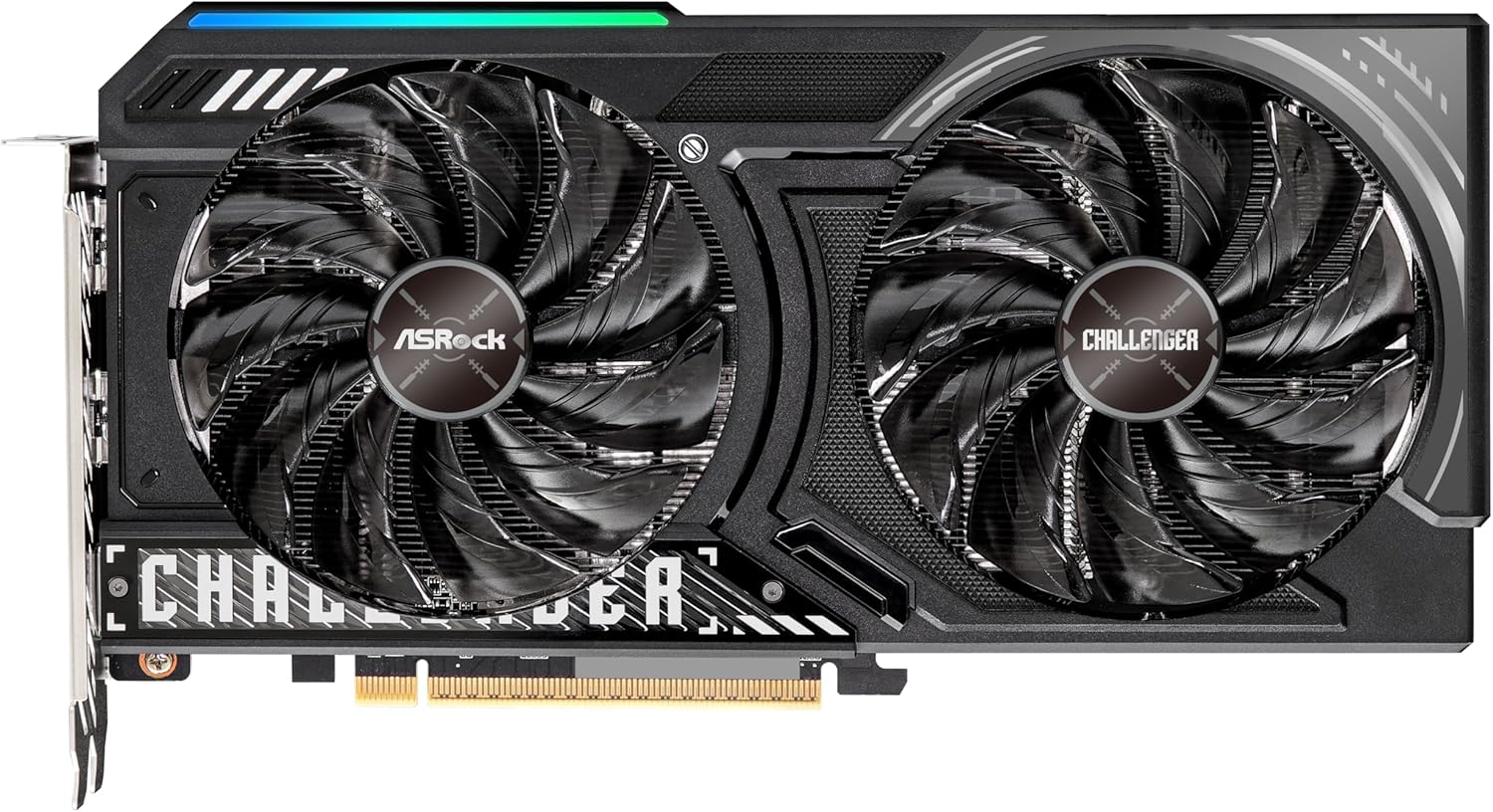
Last updated: April 2026
Some links on this page are affiliate links. If you buy through them we may earn a small commission at no extra cost to you.
The best GPUs under $500 2026 start with one clear answer: the RX 9060 XT 16GB, and it isn’t particularly close. At current street prices of around $450 to $480, it delivers strong 1440p performance, 16GB of VRAM, and a longevity story that nothing else in this price range matches. Every other option in this segment is real, but each one comes with a tradeoff you need to understand before you spend your money.
The $400 to $500 GPU segment looks competitive on paper. In practice, the decision is simpler than most articles make it. There is one no-compromise pick, one option for buyers who specifically want NVIDIA’s feature ecosystem, and one genuinely strong budget card for buyers who need to stay closer to $250. We cross-referenced the major reviews, checked current pricing, and the hierarchy is clear.
Prices in this segment are volatile right now due to ongoing memory shortages affecting VRAM supply. Every figure in this article reflects current Amazon street pricing as of April 2026. Check the links before ordering because these numbers move week to week.
On This Page
- Quick Answer
- Quick Picks
- GPU Comparison at a Glance
- Real Gaming Performance at 1080p and 1440p
- The VRAM Problem Under $500
- AMD vs NVIDIA Under $500
- Best GPU Breakdown
- Frequently Asked Questions
- Final Verdict
Quick Answer: Best GPUs Under $500 2026
For most people building or upgrading right now, the answer is the AMD Radeon RX 9060 XT 16GB. It handles 1080p at high refresh rates without breaking a sweat, delivers strong 1440p performance at high settings, and its 16GB of VRAM gives it a longevity advantage that 8GB cards in this range simply cannot match. At $450 to $480, it is not cheap, but it is the only GPU in this price window that does not ask you to accept a meaningful compromise.
If you specifically want NVIDIA, the RTX 5060 Ti 8GB is the pick. DLSS 4 with Multi Frame Generation is genuinely excellent, and the raw performance at 1080p is competitive. But you are accepting a real limitation with 8GB of VRAM, and at 1440p that limitation is already showing up in demanding titles. You are choosing features over longevity, and you need to go in with eyes open.
For buyers who need to stay around $250 to $300, the Intel Arc B580 is a legitimate option with 12GB of VRAM and improved drivers. It is not for everyone, but for tech-comfortable buyers on a tight budget it punches well above its price.
Quick Picks
Three picks covering every budget under $500. One clear winner, one feature-driven alternative, and one genuinely strong value for buyers who need to stay closer to $250.
GPU Comparison at a Glance
A side-by-side look at every GPU in this price range, including what each one asks you to give up.
| GPU | VRAM | Power Draw | Best For | Compromise |
|---|---|---|---|---|
| RX 9060 XT 16GB | 16GB GDDR6 | ~182W | 1080p and 1440p | Nvidia ecosystem |
| RTX 5060 Ti 8GB | 8GB GDDR7 | ~180W | 1080p, DLSS builds | VRAM |
| Intel Arc B580 | 12GB GDDR6 | ~190W | Budget 1080p | Stability |
| RX 9060 XT 8GB | 8GB GDDR6 | ~170W | Strict $300 budget | VRAM + longevity |
Real Gaming Performance at 1080p and 1440p
| Game / Resolution | RX 9060 XT 16GB | RTX 5060 Ti 8GB | Intel Arc B580 |
|---|---|---|---|
| Call of Duty 1080p | ~160 fps | ~125 fps | ~90 fps |
| Call of Duty 1440p | ~105 fps | ~85 fps | ~58 fps |
| Cyberpunk 2077 1080p | ~95 fps | ~98 fps | ~72 fps |
| Cyberpunk 2077 1440p | ~65 fps | ~68 fps | ~48 fps |
| Fortnite 1080p | ~175 fps | ~195 fps | ~140 fps |
| Fortnite 1440p | ~114 fps | ~130 fps | ~95 fps |
Frame rates are averages from multiple review sources including Tom’s Hardware, TechSpot, GamersNexus, and Geeky Gadgets. Settings are high to ultra unless noted. Performance varies by system configuration, driver version, and in-game settings. Call of Duty results based on Black Ops 6, the current version of Call of Duty. RTX 5060 Ti 8GB leads in Fortnite due to DLSS 4 advantage in that title.
The VRAM Problem Under $500
This is the most important thing to understand before you spend money in this price range.
VRAM is the memory your GPU uses to store textures, geometry, and rendering data. When a game demands more VRAM than your card has available, performance does not just drop smoothly. It stutters, drops frames aggressively, and in some cases becomes unplayable at settings that should be well within reach.
In 2025 and into 2026, we crossed a threshold. Games like Stalker 2, Spider-Man 2, Ratchet and Clank: Rift Apart, and Oblivion Remastered are actively exposing 8GB cards at 1440p on settings that are not even maxed out. TechSpot found the RX 9060 XT 8GB running 26% slower than the 16GB model in Spider-Man 2 at 1440p, with 1% low frame rates 38% worse. Those are not theoretical future problems. They are happening now in titles you can buy today.
The 8GB cards at this price range are not future-proofed. They are last-year solutions at this-year prices.
If you are spending $400 or more on a GPU in 2026, buying 8GB is a short-term decision whether you realize it or not.
Why 16GB Matters Right Now
The RX 9060 XT 16GB costs more than its 8GB sibling, but the extra VRAM changes the entire longevity story. You are not paying for more performance today. You are paying for consistent performance across the next three to four years as games continue to push texture demands higher. Frame generation technology also consumes VRAM. AI upscaling consumes VRAM. The more features you want to use, the more headroom you need.
Tom’s Hardware put it plainly: doubling your VRAM at this price tier is a no-brainer after seeing how game texture demands have trended over the past few years.
What About the RTX 5060 Ti 8GB?
The RTX 5060 Ti 8GB is a fast card with an excellent feature set. DLSS 4 with Multi Frame Generation is genuinely better than FSR 4 in a lot of supported titles. But at 1440p, the 8GB VRAM is already a real constraint in demanding games, and that gap only grows over time. Multiple major publications have explicitly said they cannot recommend 8GB cards above $350 in 2026. If you want the RTX 5060 Ti, the 16GB version at around $550 is the one that makes sense long-term, but that is outside our $500 ceiling.
What GPU Should You Actually Buy Under $500?
If you can stretch to $450 to $480, buy the RX 9060 XT 16GB. It is the only GPU in this price range that does not ask you to accept a compromise on VRAM, performance, or longevity. If your budget is firm at $250 to $300, the Arc B580 with 12GB of VRAM is a stronger long-term choice than any 8GB card at a similar price. The RTX 5060 Ti 8GB sits in the middle: fast, feature-rich, and genuinely limited by memory in a way that will only become more visible over time.
AMD vs NVIDIA Under $500
The decision between AMD and NVIDIA at this price tier is not really about raw performance. It is about what you are optimizing for.
AMD wins on value and VRAM. The RX 9060 XT 16GB delivers comparable rasterization performance to the RTX 5060 Ti at a lower price, with double the VRAM. FSR 4 has closed a significant portion of the upscaling quality gap with DLSS 4. For buyers who play a wide range of titles and want the card that handles everything without settings babysitting, AMD is the straightforward answer.
NVIDIA wins on feature ecosystem. DLSS 4 with Multi Frame Generation is the best upscaling and frame generation solution available right now. If you play a lot of DLSS-supported titles, the visual quality and frame generation advantage is real. NVIDIA’s drivers are also more consistent across a broader range of older titles and DX11 games. If those things matter to you specifically, the RTX 5060 Ti 8GB is a legitimate choice. Just understand what you are giving up on VRAM.
The honest summary: for most gamers, the AMD option is the smarter long-term buy. For NVIDIA loyalists who specifically value DLSS 4, the RTX 5060 Ti 8GB is the pick, with the understanding that the 8GB limitation is real and will become more visible over time.
Best GPU Breakdown
A full breakdown of each primary pick, including who it is for and what it asks you to give up.
Best Overall GPU Under $500: AMD Radeon RX 9060 XT 16GB
- Architecture: AMD RDNA 4
- VRAM: 16GB GDDR6
- Power Draw: ~182W
- Ideal For: 1080p high refresh, 1440p high settings, buyers who want longevity
At 1080p, the RX 9060 XT 16GB is essentially overkill. It will push high refresh rates in every esports title without effort and handle demanding AAA games at ultra settings comfortably. The real story is at 1440p, where it delivers genuinely strong performance across a wide range of titles and does not stutter or throttle when games push texture demands higher.
The VRAM advantage over 8GB alternatives is not theoretical. In Spider-Man 2, Stalker 2, and Oblivion Remastered, the difference between 8GB and 16GB is already visible in frame consistency, not just averages. Over a three to four year ownership window, that gap only widens.
Ray tracing is the honest weakness. RDNA 4 has improved AMD’s ray tracing performance meaningfully over last generation, but NVIDIA still holds a clear advantage in heavy RT scenarios. If ray tracing is a priority, the RTX 5060 Ti 8GB closes that gap at the cost of VRAM headroom. FSR 4 upscaling is competitive with DLSS 4 in supported titles and continues to improve.
Who should buy it: Anyone building or upgrading with a $400 to $500 budget who wants strong performance today and is not willing to make a VRAM bet they may regret in 18 months.
Bottom line: The only GPU under $500 in 2026 that does not ask you to compromise on something important.
Best NVIDIA GPU Under $500: NVIDIA GeForce RTX 5060 Ti 8GB
- Architecture: NVIDIA Blackwell
- VRAM: 8GB GDDR7
- Power Draw: ~180W
- Ideal For: 1080p gaming, DLSS-heavy builds, NVIDIA ecosystem users
At 1080p, the RTX 5060 Ti 8GB is an excellent card. Raw rasterization performance is competitive with the RX 9060 XT 16GB in the majority of titles, and DLSS 4 with Multi Frame Generation is a genuine differentiator for buyers who play supported titles. The upscaling quality is better than FSR 4 in most comparisons, and the frame generation implementation is more mature.
The problem is at 1440p, and it is not subtle. In titles that push VRAM hard, the 8GB limitation is already causing real performance issues in 2026. Stalker 2, Spider-Man 2, and Ratchet and Clank: Rift Apart have all shown the 8GB RTX 5060 Ti struggling in scenarios where the RX 9060 XT 16GB runs cleanly. Tom’s Hardware declined to recommend the 8GB variant to buyers spending over $350 on a GPU. GamersNexus called 8GB cards at this price tier inappropriate for the market.
If you want the RTX 5060 Ti with 16GB of VRAM, that version exists at around $550. It is outside our ceiling but worth knowing about if you can stretch.
Who should buy it: Buyers who specifically value DLSS 4 and Multi Frame Generation, play primarily at 1080p, and understand they are accepting a VRAM tradeoff in exchange for NVIDIA’s feature ecosystem.
Bottom line: The best NVIDIA card under $500, with a real caveat you need to accept before buying.
Best Budget GPU Under $500: Intel Arc B580
- Architecture: Intel Battlemage (Xe2)
- VRAM: 12GB GDDR6
- Power Draw: ~190W
- Ideal For: Budget 1080p gaming, tech-comfortable buyers, tight-budget builds
The Intel Arc B580 is the most interesting budget GPU of this generation, and also the most misunderstood. Built on Intel’s Battlemage architecture with 20 Xe2 cores and 12GB of GDDR6, it offers more VRAM than any 8GB card at a price point well below both the RX 9060 XT and RTX 5060 Ti. For buyers who need to stay around $250, nothing else comes close to this combination of VRAM and performance.
Driver quality has improved significantly since launch. The CPU overhead issue that affected older processors has been largely resolved for Zen 3 and newer CPUs through driver updates released through late 2025 and into 2026. Intel added XeSS 3 Multi-Frame Generation in February 2026, providing meaningful frame rate boosts in supported titles. Shader pre-compilation support was also added, reducing first-load stuttering that was a complaint at launch.
The honest caveats remain. In some older DX11 titles, compatibility and performance can still be inconsistent. The B580 is not the right card for someone who wants to install and forget. It rewards buyers who stay on top of driver updates and understand that a small number of games may need troubleshooting. GamersNexus, as of November 2025, still recommended it only to buyers comfortable with occasional troubleshooting.
At 1080p in modern titles, the B580 is a genuinely capable card. At 1440p, expect playable but not premium performance, particularly in demanding AAA games. The 12GB VRAM gives it a longevity advantage over 8GB alternatives at similar prices. If the B580 is creeping toward $350 or higher at the time you are reading this, the value argument starts to fall apart. At that price you are better off stretching toward the RX 9060 XT.
Who should buy it: Budget-conscious buyers who need to stay around $250 to $300, are comfortable managing drivers, and understand the card’s limitations. Not the pick for first-time builders who want a plug-and-play experience.
Bottom line: The strongest value under $300 in 2026, with real caveats that matter for certain buyers.
Building a Full PC Around These GPUs?
If you are pairing one of these GPUs with a full build, we have done the work for you. Our $1,000 Gaming PC Build for 1080p uses the RX 9060 XT as its primary GPU and walks through every compatible component at that budget. For buyers targeting 1440p at $1,000, the $1,000 Gaming PC Build for 1440p covers the same GPU tier. Both builds are updated for 2026 pricing and include platform recommendations for AM4 and AM5.
Frequently Asked Questions
Is 8GB of VRAM enough for gaming in 2026?
For 1080p esports titles and older games, 8GB is still adequate. For modern AAA games at 1440p with high texture settings, 8GB is already causing real performance issues in titles like Spider-Man 2, Stalker 2, and Oblivion Remastered. A card you buy today should last three to four years minimum. If 8GB is already struggling in some 2026 titles, it will struggle in more titles by 2027 and 2028. At this price range, 16GB is the safer long-term choice.
Should I wait for better GPUs under $500?
Tom’s Hardware has reported that NVIDIA is not planning new RTX gaming GPUs in 2026, with the next generation likely arriving in 2028. AMD’s RDNA 5 is not expected to reach the mainstream segment this year either. What you see is what you get for the foreseeable future. If you need a GPU now, buying the RX 9060 XT 16GB at current prices is a defensible decision. Waiting is reasonable, but there is no major new launch on the horizon that changes the value equation significantly.
AMD or NVIDIA under $500?
For most buyers, AMD. The RX 9060 XT 16GB delivers comparable rasterization performance to the RTX 5060 Ti at a lower price with double the VRAM. If you specifically play DLSS 4 supported titles and value NVIDIA’s upscaling quality and Multi Frame Generation, the RTX 5060 Ti 8GB is a legitimate choice. If you do not have a specific reason to choose NVIDIA, AMD is the better long-term value at this price point.
Can these GPUs handle 1440p gaming?
The RX 9060 XT 16GB handles 1440p comfortably at high settings in most titles. The RTX 5060 Ti 8GB handles 1440p well in most titles but runs into VRAM limitations in more demanding games. The Arc B580 is playable at 1440p in lighter titles but is primarily a 1080p card. If 1440p is your target resolution, the RX 9060 XT 16GB is the only pick in this price range that handles it without meaningful compromise.
Is the Intel Arc B580 reliable in 2026?
More reliable than it was at launch, but not fully beginner-proof. Driver updates through 2025 and into 2026 have resolved the CPU overhead issue for modern platforms and improved game compatibility significantly. XeSS 3 Multi Frame Generation was added in February 2026. Some older DX11 titles still have occasional issues. If you are comfortable staying on top of driver updates and doing occasional troubleshooting, it is a strong value. If you want plug-and-play reliability, the RX 9060 XT 16GB is the better fit.
Final Verdict
Buying the wrong GPU in this price range is not a small mistake. It is a decision you will live with for three to four years, and the difference between a card that ages well and one that starts showing cracks in 18 months is exactly what this article is designed to help you avoid.
The AMD Radeon RX 9060 XT 16GB is the right call for most people shopping under $500 right now. It is not the flashiest option, it does not have NVIDIA’s feature ecosystem, and it will not win every benchmark head to head. What it does is handle everything a mainstream gamer needs today without asking you to accept a compromise that will bite you later. Sixteen gigabytes of VRAM at this price is genuinely rare, and the performance at both 1080p and 1440p is strong enough that you will not feel like you left something on the table.
If DLSS 4 and Multi Frame Generation are important to you, the RTX 5060 Ti 8GB is a real GPU with real strengths. Go in knowing what you are trading. Eight gigabytes of VRAM is already a limitation in some 2026 titles and that situation gets worse over time, not better. If you can stretch your budget to around $550, the 16GB version of the RTX 5060 Ti is the NVIDIA card that makes sense long-term. Under $500, you are accepting a tradeoff.
For buyers who need to stay closer to $250, the Intel Arc B580 is the strongest budget option available. Twelve gigabytes of VRAM at that price is genuinely competitive, and the driver situation has improved enough that most buyers on modern platforms will have a solid experience. Just go in understanding that it rewards informed buyers more than plug-and-play builders.
Check prices before you order. This segment moves fast, and the right pick today might shift if the RX 9060 XT 16GB dips closer to MSRP or the RTX 5060 Ti 8GB comes down further. Use the links above to see current pricing and make the call that fits your budget on the day you buy.
The mistake most buyers make in this price range is chasing features instead of avoiding limitations. The RX 9060 XT 16GB avoids them.
Not sure which monitor pairs best with your new GPU? Use our GPU Monitor Match Tool to get a matched recommendation in seconds.