
Last updated: March 2026
Some links on this page are affiliate links. If you buy through them we may earn a small commission at no extra cost to you.
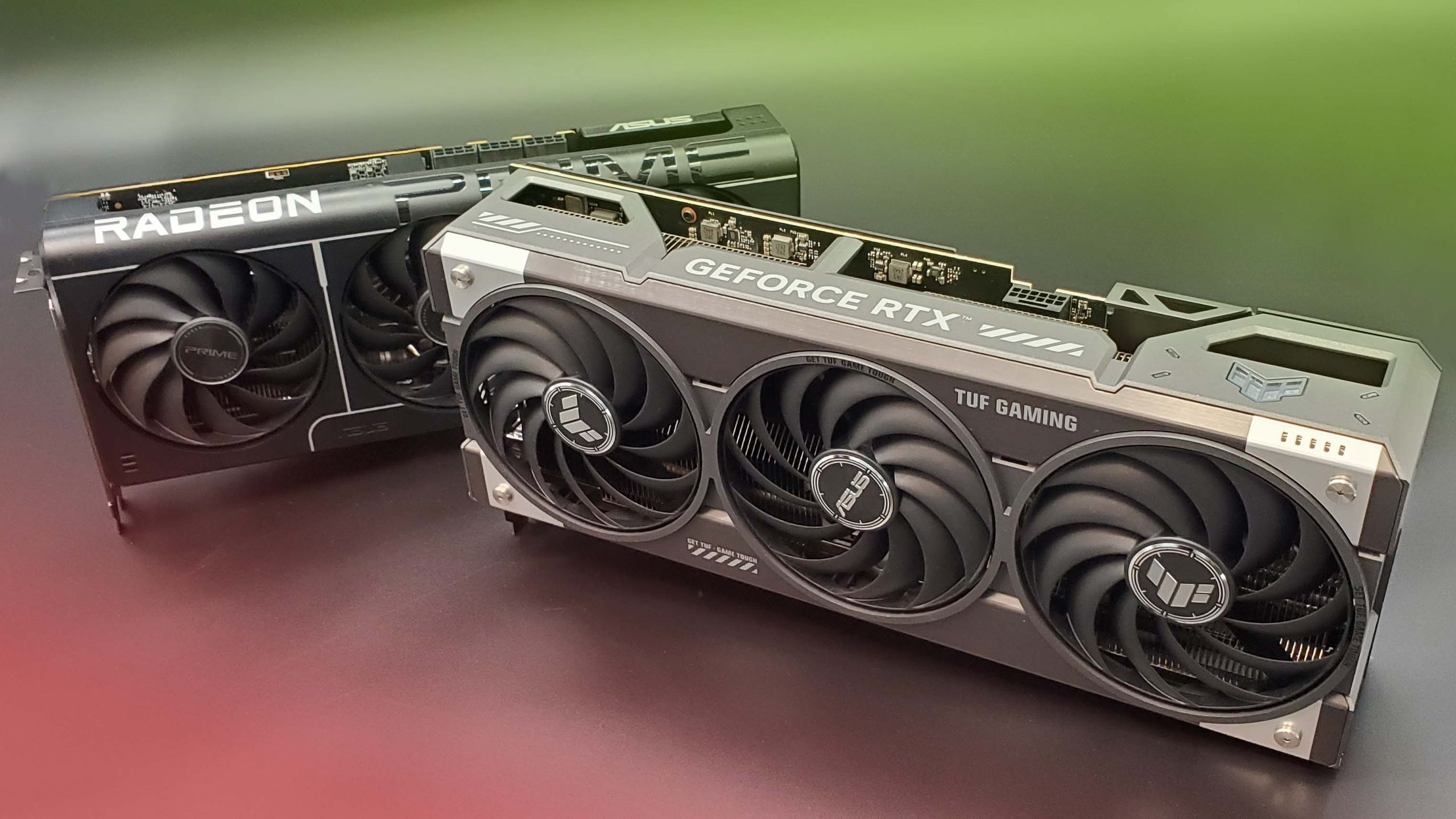
For most 1440p gamers, the RX 9070 XT is the better buy. It delivers roughly 17 to 21% more native gaming performance than the RTX 5070, carries 16GB of VRAM versus 12GB, and at reasonable street pricing represents one of the strongest value cards AMD has released in years. The RTX 5070 is not a weak card. It earns its place for buyers who specifically want DLSS 4, Multi Frame Generation, NVIDIA’s ray tracing depth, or creator-side tools. But for pure gaming value at 1440p, the 9070 XT wins the head-to-head.
The one thing that can flip that recommendation is current pricing. Both cards have drifted above their launch MSRPs at various points since release, and the gap between them on any given day can change the math. We built this guide to give you a clear answer at any price point, not just at launch-day numbers. Check both cards before you decide.
On This Page
- Quick Answer
- Buy This If…
- At a Glance
- Core Differences
- 1440p Gaming Performance
- Ray Tracing and Upscaling: The Honest Picture
- VRAM and Long-Term Comfort
- The Pricing Reality
- Which One Should You Buy
- Frequently Asked Questions
- Final Verdict
Quick Answer: RX 9070 XT vs RTX 5070
The RX 9070 XT is the better card for most 1440p gamers. It leads the RTX 5070 by roughly 17 to 21% in native gaming performance at 1440p and 4K, carries 16GB of VRAM on a 256-bit bus, and gives you more headroom to hit high refresh rates without depending on upscaling. At or near launch MSRP, it is the clear pick.
The RTX 5070 is the right choice if you specifically want DLSS 4 with Multi Frame Generation, NVIDIA’s ray tracing ecosystem, or creator and streaming tools. It is also worth a serious look if current street prices have the 9070 XT running $100 or more above the 5070 when you check today.I f you are choosing between RTX 5070 models, see our RTX 5070 vs RTX 5070 Ti 2026 guide to decide whether stepping up to the Ti makes sense.
Buy This If…
RX 9070 XT vs RTX 5070: At a Glance
| Spec | AMD RX 9070 XT | Nvidia RTX 5070 |
|---|---|---|
| Launch MSRP | $599 | $549 |
| VRAM | 16GB GDDR6 | 12GB GDDR7 |
| Memory Bus | 256-bit | 192-bit |
| Architecture | AMD RDNA 4 | NVIDIA Blackwell |
| Board Power | 304W | ~250W |
| 1440p Performance | 17 to 21% faster on average | Baseline |
| Upscaling | FSR 4 | DLSS 4 + Multi Frame Gen |
| Ray Tracing | Competitive in mixed RT | Stronger in path tracing |
| Best For | Native gaming value | NVIDIA feature stack |
Core Differences
These four dimensions are what actually drive the decision between these two cards. Everything else is noise.
1440p Gaming Performance
This is where the RX 9070 XT makes its strongest case. Across a wide range of tested titles, it leads the RTX 5070 by a meaningful margin at 1440p. In a 57-game benchmark suite, the 9070 XT averaged approximately 17% faster at 1440p and 21% faster at 4K. That is a real difference that shows up in games you actually play, not just synthetic benchmarks.
Some specific examples make the gap concrete. In Cyberpunk 2077 at 1440p the 9070 XT led by roughly 25%. In Starfield it was around 31% ahead. In Horizon Forbidden West the gap was approximately 34%. These are not cherry-picked outliers. They reflect how AMD’s RDNA 4 architecture stacks up against Blackwell in the rasterized workloads that make up the majority of actual gaming.
It is not a complete sweep. The RTX 5070 holds its own in certain titles and actually leads in a handful of them. Hunt: Showdown 1896 is the clearest example where the 5070 outpaces the 9070 XT by around 12% at 1440p. Final Fantasy XIV: Dawntrail also skews in NVIDIA’s favor. If those specific games are central to how you play, that is worth knowing. But across a broad game library, the 9070 XT is the faster card at 1440p by a consistent and meaningful margin.
For a 1440p 165Hz or 144Hz monitor, that performance lead matters directly. More native headroom means more titles hitting your target refresh rate without needing to dial back settings or lean on upscaling to fill the gap. If you want to actually use a high-refresh display rather than chase it, the 9070 XT is the more capable card for that job.
| Game | RX 9070 XT (1440p) | RTX 5070 (1440p) | Difference |
|---|---|---|---|
| Cyberpunk 2077 | ~112 FPS | ~90 FPS | 9070 XT +25% |
| Starfield | ~98 FPS | ~75 FPS | 9070 XT +31% |
| Horizon Forbidden West | ~108 FPS | ~81 FPS | 9070 XT +34% |
| Call of Duty: Black Ops 6 | ~165 FPS | ~98 FPS | 9070 XT +68% |
| Hunt: Showdown 1896 | ~88 FPS | ~100 FPS | RTX 5070 +12% |
| Final Fantasy XIV: Dawntrail | ~167 FPS | ~184 FPS | RTX 5070 +10% |
FPS figures are approximate averages based on current review data at 1440p ultra settings. Actual performance varies by CPU, RAM, drivers, and system configuration. Always check current benchmarks before purchasing.
Not sure how either card pairs with your monitor? Use our GPU Monitor Match Tool to find the right setup for how you actually play.
Ray Tracing and Upscaling: The Honest Picture
Most comparison articles get this section wrong by defaulting to “NVIDIA wins ray tracing, therefore buy NVIDIA.” That framing is too simple in 2026, and it does not help you make a better decision. Here is what actually matters.
Where NVIDIA’s RT Advantage Is Real
In heavily path-traced titles, NVIDIA still has a clear advantage. Games like Indiana Jones and the Great Circle with path tracing enabled illustrate this well. The RTX 5070 can handle path-traced rendering at playable settings in ways the 9070 XT currently cannot. If you specifically want to play games with full path tracing enabled and that experience matters to you, the RTX 5070 is the more capable card for it.
Where the Gap Is Smaller Than You Think
RDNA 4 has made genuine ray tracing progress. In mixed-load RT titles, the kind that use ray tracing for shadows, reflections, and ambient occlusion without going full path-traced, the 9070 XT performs much more competitively than AMD’s previous generation did. For most games that use ray tracing as a quality enhancement rather than a foundation, the RT difference between these two cards is often not the deciding factor it once would have been.
Upscaling: DLSS 4 vs FSR 4
DLSS 4 is NVIDIA’s strongest argument outside of raw native performance. Multi Frame Generation can dramatically increase frame rates in supported titles, and DLSS 4’s image quality at Quality and Balanced modes is excellent. The catch is game support. DLSS 4 with Multi Frame Generation requires developer integration, and not every game has it yet.
FSR 4 is a real improvement over prior versions. In games that support it natively, the quality difference between FSR 4 and DLSS 4 is closer than it has ever been. The problem is that in games where only older FSR versions are supported, the quality gap widens considerably. If your game list overlaps heavily with DLSS 4 supported titles and you want frame generation, the RTX 5070 gives you that tool. If you are focused on native performance and your games do not depend heavily on DLSS 4 specifically, the 9070 XT’s raw advantage is the more consistent benefit.
VRAM and Long-Term Comfort
The 16GB versus 12GB difference is not a marketing talking point. It is a real consideration at this tier in 2026, and one of the RX 9070 XT’s strongest arguments for buyers thinking beyond the next twelve months.
At 1440p with ultra texture settings, modern AAA titles are increasingly touching or exceeding 10GB of VRAM in demanding scenes. Games like Hogwarts Legacy, The Last of Us Part I, and newer releases with high-resolution texture packs can push VRAM hard. The 9070 XT’s 16GB gives you more runway before hitting that ceiling. The RTX 5070’s 12GB is manageable today but gives you less buffer as games continue to push harder.
The bus width difference reinforces this. The 9070 XT’s 256-bit bus moves data more efficiently under heavy load than the 5070’s 192-bit bus, even accounting for GDDR7’s higher per-pin bandwidth on the NVIDIA side. In texture-heavy workloads, this translates to smoother frame times and less stuttering at ultra settings.
If you plan to keep this card for three or more years, the 9070 XT ages better on paper. The 12GB on the RTX 5070 is not a dealbreaker today, but it is the spec most likely to feel limiting first as games push harder at 1440p. Spending in this tier and accepting less VRAM is the one tradeoff worth thinking through carefully before you buy.
The Pricing Reality
This section changes depending on when you read it, which is exactly why it exists. GPU pricing in 2026 is volatile. Both cards launched at aggressive MSRPs and both have drifted above them since release. The performance argument for the 9070 XT is strong, but it only holds if the price premium over the 5070 is reasonable.
At time of writing, the RX 9070 XT is available in the $630 to $730 range depending on model and retailer, against a $599 MSRP. The RTX 5070 is sitting closer to its $549 MSRP, generally available in the $600 to $650 range. That puts the real-world gap between the two cards at roughly $30 to $100 depending on where you shop. That range is wide enough that the right answer can legitimately differ by the time you are reading this.
Here is the rule we use:
- RX 9070 XT is within $75 of the RTX 5070: Buy the 9070 XT. The performance and VRAM advantage is worth a modest premium at any price within this range.
- RX 9070 XT is $100 or more above the RTX 5070: The RTX 5070 becomes a serious contender. You are paying meaningfully more for a card that loses in native gaming but wins in features. That trade needs a real reason.
- Both cards are near their MSRP: Buy the 9070 XT. The value case is clear when pricing behaves.
- Both cards are heavily marked up: Consider waiting. This market has corrected before and will again. Patience is a legitimate strategy at this tier.
Use the Check Price buttons throughout this article to see where both cards sit today before you decide.
Which One Should You Buy
- Best for most 1440p gamers: RX 9070 XT. More native performance, more VRAM, and better long-term headroom. This is the default recommendation for anyone building around a 1440p 144Hz or 165Hz monitor.
- Best for competitive shooters at high refresh: RX 9070 XT. Higher native frame rates mean more headroom to push 165Hz or 240Hz without upscaling. Raw performance wins here.
- Best for AAA single-player at ultra settings: RX 9070 XT. The 16GB VRAM and wider bus give you the best experience in texture-heavy titles today and better aging as those games push harder.
- Best for DLSS 4 and frame generation users: RTX 5070. If your game list has strong DLSS 4 support and you want to push frame rates beyond native performance, the RTX 5070 is built for that use case.
- Best for creators and streamers: RTX 5070. NVIDIA’s Studio drivers, NVENC encoder, and Broadcast tools are meaningfully better for content creation and streaming workflows. If the GPU does double duty, NVIDIA’s ecosystem advantage is real.
- Best when the price gap is large: RTX 5070. If the 9070 XT is $100 or more above the 5070 today, the performance gap does not justify the premium. Check prices on both and let the current market decide.
Frequently Asked Questions
Is the RX 9070 XT better than the RTX 5070 for 1440p gaming?
Yes, in most games. The RX 9070 XT leads the RTX 5070 by roughly 17 to 21% at 1440p on average across a wide range of titles. That gap is consistent enough to be meaningful rather than a benchmark anomaly. The RTX 5070 leads in a small number of specific titles, but for the majority of 1440p gaming the 9070 XT delivers more frames at native settings.
Does the RTX 5070’s 12GB VRAM cause problems at 1440p?
Not in most games today, but it is the spec most likely to cause problems first as titles push harder. At 1440p ultra settings with high-resolution textures, some current games are already touching or approaching 10GB of VRAM usage in demanding scenes. The 12GB on the RTX 5070 is workable right now, but the 9070 XT’s 16GB gives you more runway before hitting that ceiling. If you plan to keep this card for three or more years, this difference matters more than it might seem today.
Is DLSS 4 worth choosing the RTX 5070 over the RX 9070 XT?
It depends entirely on whether you actually use it. DLSS 4 with Multi Frame Generation is a genuinely powerful tool in supported games and can push frame rates well beyond what the GPU achieves natively. If your games heavily support DLSS 4 and frame generation is important to your experience, it is a real argument for the RTX 5070. If you primarily play games without DLSS 4 support, you are trading native performance for a feature you may not regularly benefit from.
Which card is better for ray tracing?
The RTX 5070 is the stronger ray tracing card, particularly in heavily path-traced titles. RDNA 4 has closed the gap meaningfully compared to previous AMD generations, and in mixed-load RT games the 9070 XT is genuinely competitive. But in the most demanding path-traced scenarios, NVIDIA still leads. If ray tracing quality across every game is a priority, the RTX 5070 is the right choice.
What PSU do I need for the RX 9070 XT or RTX 5070?
For the RX 9070 XT with its 304W typical board power, we recommend a minimum 750W 80+ Gold PSU with headroom for your full system. Our pick is the Corsair RM750e 750W for most builds. The RTX 5070 draws around 250W, making a quality 650W to 750W unit sufficient, but we still recommend 750W for headroom and future flexibility. Never cut costs on the PSU regardless of which GPU you choose.
Which card pairs best with a 1440p 165Hz monitor?
The RX 9070 XT. At 1440p 165Hz, you want a card that can push toward or past that refresh rate in most titles without leaning heavily on upscaling, and the 9070 XT does that more consistently than the RTX 5070. Both cards are capable at this resolution, but the 9070 XT gives you more native headroom to actually use the display you paid for. See our Best 1440p Gaming Monitors 2026 guide for display recommendations to pair with either card.
Which build should I pair either card with?
Both cards are a natural fit for our Best $1,500 Gaming PC Build for 1440p 2026, which uses the RX 9070 XT as the primary GPU with the RTX 5070 as an alternative. If you are stepping up in budget, both cards are also covered in our Best $2,000 Gaming PC Build. Either build gives you a solid platform for whichever GPU you choose.
Final Verdict
For most gamers building a 1440p setup in 2026, the RX 9070 XT is the better buy. It delivers more native gaming performance, more VRAM, and a wider memory bus than the RTX 5070 at a price difference that is easy to justify when both cards are anywhere near their launch MSRPs. For a 1440p high-refresh build, it gives you more headroom to hit your target frame rates without depending on upscaling, and 16GB of VRAM that will serve you better as games push harder over the life of the card.
The RTX 5070 is not a consolation prize. It is the right card for a specific type of buyer: someone who genuinely values DLSS 4 with Multi Frame Generation, wants NVIDIA’s ray tracing depth in path-traced titles, or needs the creator and streaming ecosystem that NVIDIA provides. If that describes you, the RTX 5070 delivers those things well and at a price that has been more stable than its AMD competitor in recent months.
Check both prices before you buy. If the 9070 XT is within $75 of the 5070, it is the clear pick. If the gap has grown to $100 or more, the RTX 5070 earns a genuine look. Either way, both cards below show current pricing so you can make the call with real numbers in hand.
More From LoadedRig
- GPU Tier List 2026: Which Graphics Card Do You Actually Need?
- Best GPUs for 1440p Gaming 2026
- Best GPUs Under $500 2026
- Best 1440p Gaming Monitors 2026
- Best Budget 1440p Gaming Monitors 2026
- Best $1,500 Gaming PC Build for 1440p 2026
- Best $2,000 Gaming PC Build for 1440p/4K 2026
- RTX 5070 vs RTX 5070 Ti 2026: Which GPU Actually Makes Sense?
- How Much VRAM Do You Need for Gaming in 2026?
- GPU Monitor Match Tool